

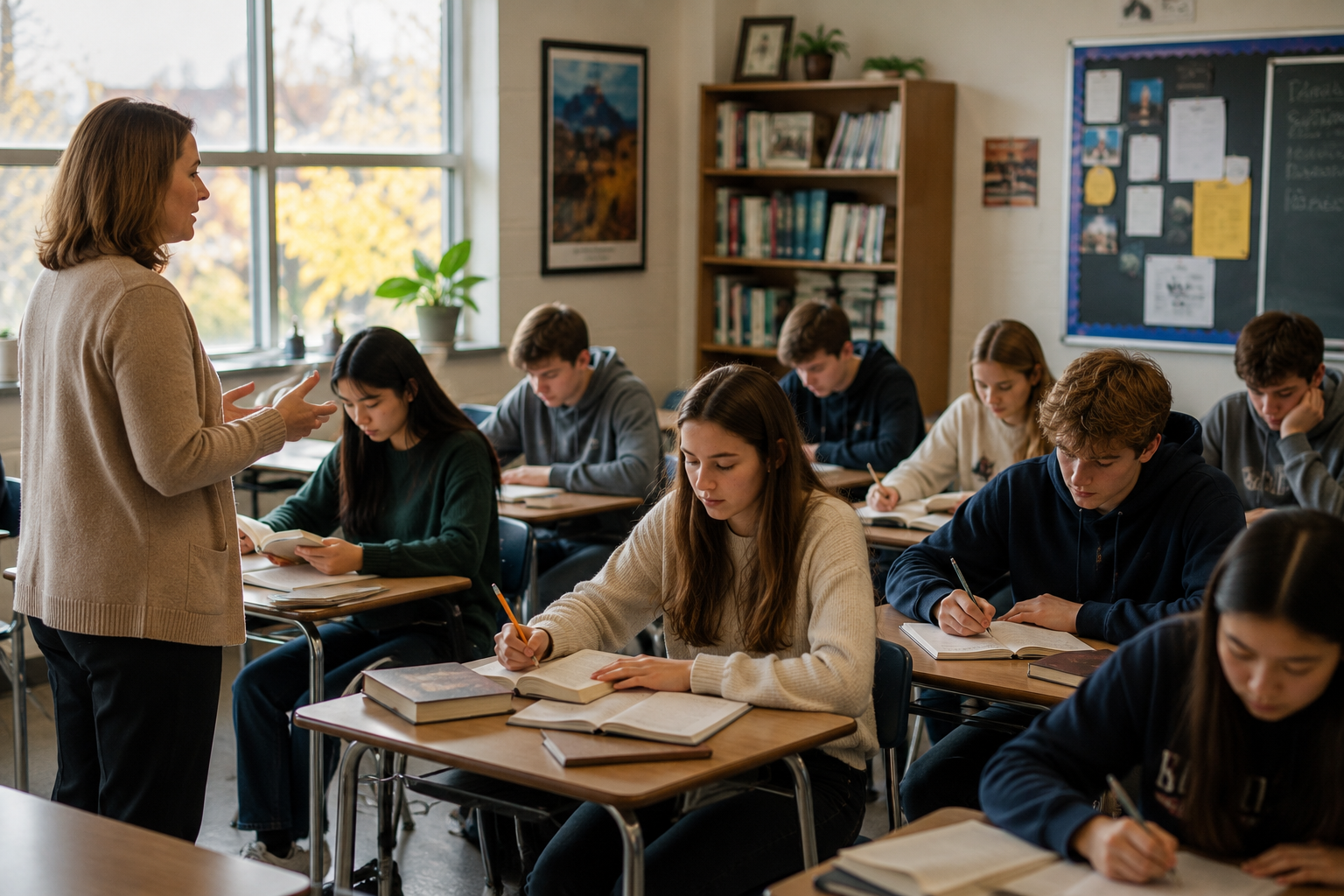
The idea of a Tech Free Classroom might sound outdated in a world dominated by smartphones, laptops, tablets, and artificial intelligence. Yet one high school teacher in Minneapolis has sparked a national conversation after proving that sometimes the simplest solutions can produce the most remarkable results.
For years, educators have worried about declining literacy skills, shorter attention spans, increased distractions, and the growing influence of digital tools in classrooms. While technology has brought countless benefits to education, many teachers have noticed a troubling pattern. Students are spending more time on screens and less time engaging deeply with books, writing, and critical thinking.
That concern motivated Maureen Mulvaney, an AP Literature and English teacher at Washburn High School in Minneapolis, to launch a bold Tech Free Classroom experiment. Instead of introducing new software or advanced educational tools, she took a completely different approach. She removed phones and laptops from her classroom and returned to traditional reading and writing methods.
What happened next surprised both students and educators.
Why the Tech Free Classroom Experiment Began
Mulvaney did not make the decision overnight.
She had become increasingly frustrated by several challenges appearing in modern classrooms. Students were frequently distracted by devices, plagiarism concerns were becoming more common, and literacy rates appeared to be falling.
Many assignments that once encouraged independent thinking were now influenced by internet searches, online resources, and increasingly powerful AI tools.
Rather than fighting these challenges one by one, Mulvaney decided to address the root cause.
With strong support from parents, she created a Tech Free Classroom environment where students would complete coursework using only paper, pencils, books, and handwritten notes.
The goal was simple: help students focus on learning without constant digital distractions.
Students Initially Struggled With the Change
The transition was not easy.
Many students had become accustomed to typing assignments, reading on screens, and using digital devices throughout the school day. Suddenly switching to paper-based learning felt uncomfortable.
Mulvaney later explained that the first day of the experiment was difficult.
Students were asked to spend ten minutes reading silently and writing by hand. What seemed like a simple exercise quickly became a challenge.
Many students could barely complete half a page of handwritten work before becoming frustrated or tired.
This reaction highlighted how dependent many young people had become on digital tools.
However, Mulvaney encouraged them to remain patient.
Building Reading and Writing Strength Gradually
Rather than expecting immediate success, Mulvaney compared the process to strength training.
Just as people do not walk into a gym and immediately lift heavy weights, students could not instantly rebuild reading and writing endurance after years of screen-focused learning.
The Tech Free Classroom approach focused on gradual improvement.
Students began with:
- Ten minutes of reading
- Short handwritten exercises
- Paper-based assignments
- Focused classroom discussions
- Reduced screen exposure
Week after week, students slowly increased their reading and writing stamina.
The improvement became impossible to ignore.
Reading Confidence Saw Extraordinary Growth
One of the most impressive outcomes involved student confidence.
Before the Tech Free Classroom experiment started in September, only 46 percent of students said they felt confident in their reading ability.
Just a few months later, by February, that number had skyrocketed to 95 percent.
This dramatic increase suggested that students were not only reading more but also feeling significantly more capable and comfortable when engaging with written material.
Confidence plays a critical role in education.
Students who believe they can succeed are often more willing to participate, take risks, and challenge themselves academically.
The results showed how powerful a focused learning environment can be.
The Tech Free Classroom Improved Writing Skills
Reading was not the only area that improved.
Writing ability also experienced significant growth.
At the beginning of the experiment, many students struggled to write even half a page by hand.
By February, most students could comfortably write at least two pages. Some students were producing five or six pages of handwritten work during classroom activities.
The Tech Free Classroom gave students an opportunity to rebuild a skill that had weakened over time.
Instead of relying on spell-checkers, predictive text, and online resources, students had to organize thoughts independently.
This process strengthened both creativity and critical thinking.
Students Preferred Writing on Paper
One of the most surprising findings came directly from student feedback.
According to survey results, 79 percent of students reported that writing on paper made it easier to organize their thoughts than writing on a screen.
This result challenges the common assumption that digital tools always improve productivity.
Students explained that paper helped them:
- Think more clearly
- Focus more effectively
- Organize ideas naturally
- Avoid distractions
- Stay engaged with assignments
The Tech Free Classroom created a space where students could concentrate fully on the writing process without interruptions.
Less Technology Meant More Original Thinking
Artificial intelligence has become a growing topic in education.
Many teachers worry that students increasingly depend on AI-generated content rather than developing their own ideas.
Several students participating in the Tech Free Classroom experiment noticed this difference themselves.
Without internet access or AI tools available during class, students had to rely on their own reasoning and creativity.
Some students reported feeling more connected to their work because every sentence reflected their own thinking.
Others explained that removing technology reduced the temptation to search for answers immediately.
As a result, they spent more time developing independent thoughts and deeper understanding.
The Classroom Became More Social
The benefits extended beyond academics.
Students also reported stronger social connections.
When laptops and phones disappeared, conversations increased.
Classmates interacted more frequently.
Discussions became more meaningful.
One student described the experience as surprisingly enjoyable because everyone connected more naturally without screens competing for attention.
The Tech Free Classroom encouraged students to be present in the moment.
Instead of focusing on notifications, messages, and online distractions, they focused on books, ideas, and human interaction.
Why Experts Are Paying Attention
The experiment arrives during a period of growing concern about technology’s impact on learning.
Research continues to explore how smartphones, social media, and AI influence attention spans, memory, and critical thinking.
Many educators argue that schools have become increasingly dependent on technology without fully understanding its long-term effects.
The Tech Free Classroom experiment offers an alternative perspective.
Rather than asking how more technology can improve education, it asks whether reducing technology might sometimes produce better results.
The success achieved in just a few months suggests this question deserves serious consideration.
A Lesson for Schools Everywhere
Not every classroom can eliminate technology completely.
Digital tools remain important for research, communication, and modern learning.
However, Mulvaney’s experience demonstrates that balance matters.
Schools may benefit from creating opportunities for:
- Screen-free reading
- Handwritten assignments
- Focused discussion periods
- Reduced digital distractions
- Independent critical thinking
The Tech Free Classroom model does not reject technology entirely.
Instead, it encourages educators to use technology thoughtfully while preserving essential learning skills.
The Bigger Message Behind the Experiment
Perhaps the most important lesson is that students have not lost the ability to read, write, or think deeply.
Instead, they may simply need environments that support those abilities.
The rapid improvement observed in the Tech Free Classroom suggests that many educational challenges are not permanent.
Given the right conditions, students can rebuild focus, strengthen literacy skills, and regain confidence surprisingly quickly.
This message offers hope for teachers, parents, and school leaders searching for solutions.
Final Thoughts
The success of this Tech Free Classroom experiment demonstrates that traditional learning methods still have tremendous value in modern education. By removing phones and laptops, Maureen Mulvaney created a learning environment that allowed students to rediscover reading, writing, concentration, and independent thinking.
The results were remarkable. Reading confidence increased from 46 percent to 95 percent, writing stamina improved dramatically, and students reported stronger focus and better organization of their ideas.
While technology remains an important educational tool, this Tech Free Classroom experiment reminds us that effective learning often depends on reducing distractions and creating space for meaningful engagement. As schools continue searching for ways to improve literacy and critical thinking, the lessons from this Tech Free Classroom may prove more relevant than ever.
Read Other Interesting news here: Cambridge Misogyny Claims
